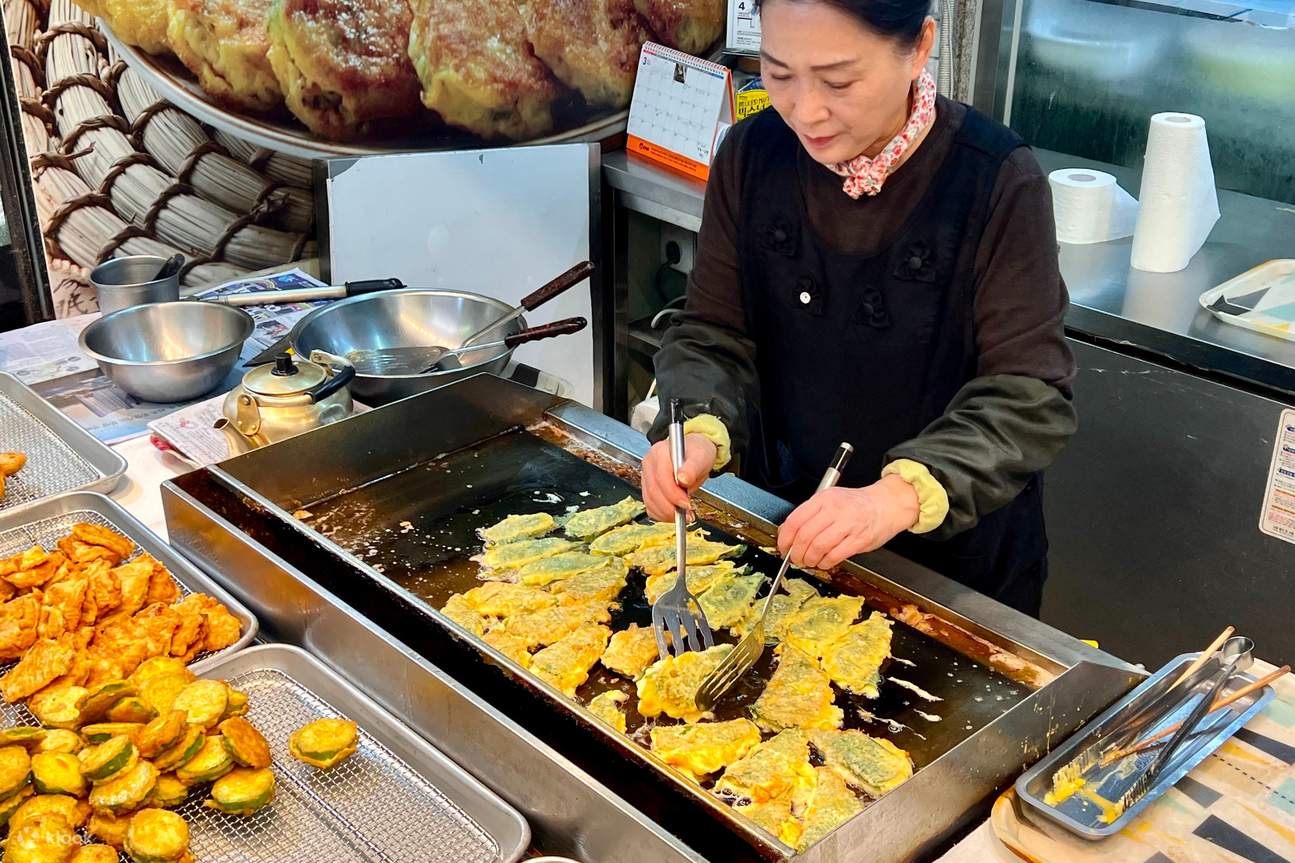
Mangwon Market is one of the easiest places in Seoul to accidentally ruin your own food crawl.
That sounds dramatic, but the problem is simple. You arrive hungry, the first famous stall looks good, you order a full portion, and fifteen minutes later you are carrying enough fried chicken for dinner while realizing there are still croquettes, noodles, tteokbokki, stuffed peppers, gimbap, hotteok, rice cakes, and traditional snacks everywhere around you.
So for this article I wanted to do something more useful than another list of foods you "have to try." I gave myself a fixed ₩20,000 market budget and built the version of Mangwon I would personally choose if variety mattered more than buying the biggest portion.
The result is seven foods for exactly ₩20,000 based on publicly listed menu prices I checked in September 2026. It includes fried chicken, a croquette, a real bowl of noodles, a stuffed pepper, gimbap, a tteok skewer, and hotteok. Some are famous. Others are here simply because they make the budget work better.
This is not an official fixed-price Mangwon package, and I would never treat market prices that way. Stalls change menus and prices. Think of this as a snapshot and a strategy: spend on variety, eat fragile foods fresh, and save portable food for later.
Planning a Mangwon food day?
Read: What to Eat at Mangwon Market: The Snacks and Street Food You Should Not Miss
Read: 24 Hours in Seoul: The Perfect First-Timer Itinerary
Read: Why Korean People Don't Always Say Exactly What They Mean
1. The ₩20,000 Plan: Seven Foods, No Random Spending
♡ The goal is not to buy the largest portion at every famous stall. It is to get as much variety as possible without wasting money or getting full immediately.
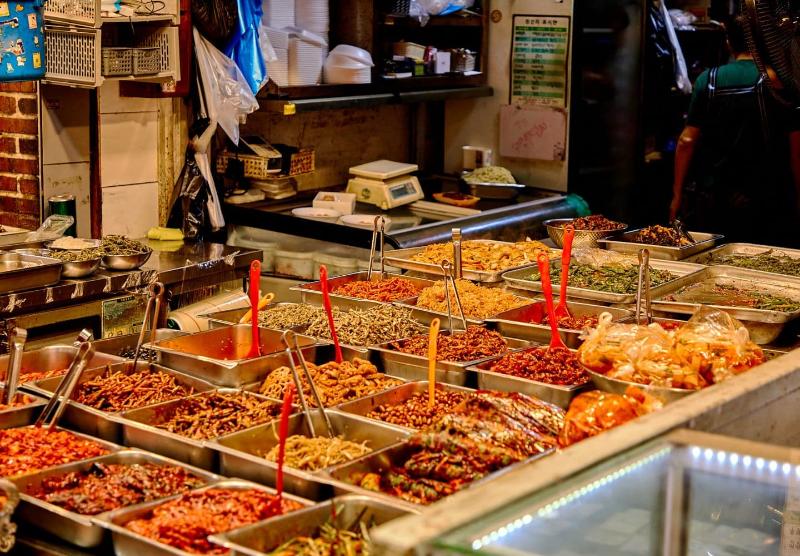
If I walked into Mangwon Market with exactly ₩20,000, I would treat it like a food crawl rather than lunch at one restaurant. Mangwon is at its best when you keep moving, notice what is being cooked in front of you, eat something, and then continue down the aisle. Spending half the budget on one giant serving defeats the reason I would come here in the first place.
My current ₩20,000 basket would be a ₩5,000 cup of Q's dakgangjeong, one ₩1,500 croquette, a ₩4,000 bowl of kalguksu, a ₩3,000 king fried pepper, a ₩1,000 tteok skewer, ₩3,500 vegetable gimbap, and one ₩2,000 hotteok. That comes to exactly ₩20,000.
My ₩20,000 Mangwon Market budget
Q's dakgangjeong cup: ₩5,000
Croquette: ₩1,500
Gohyangjip kalguksu: ₩4,000
King fried green pepper: ₩3,000
Tteok skewer: ₩1,000
Vegetable gimbap: ₩3,500
Hotteok: ₩2,000
Total: ₩20,000
There is one important warning before building your own version: these are menu prices I checked in September 2026, not permanent market prices. Small independent food businesses can change prices, portions, operating days, or menus without much warning. I would always look at the actual menu board before ordering instead of arriving determined to reproduce this down to the last ₩500.
I also think this exact basket makes more sense for two people sharing than one person trying to finish everything immediately. There is a bowl of noodles, chicken, bread, rice, fried food, and dessert in here. A solo traveler can still do it, but I would plan to take the gimbap or leftover chicken toward the Han River instead of forcing down seven foods just because the internet called it a challenge.
2. ₩5,000: I Would Start With a Cup of Q’s Dakgangjeong
♡ It is one of the foods Mangwon is known for, but the cup portion makes much more sense for a budget crawl than buying half a chicken.
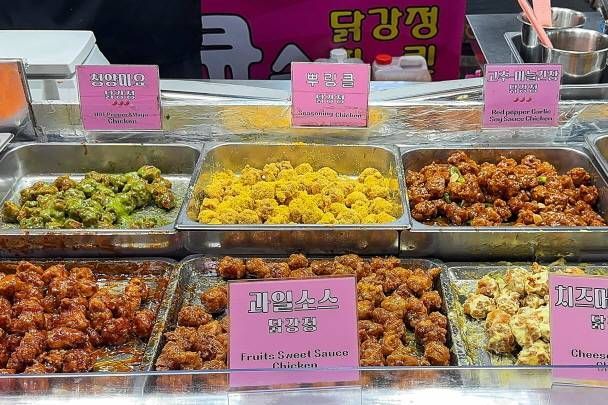
My biggest single expense would be Q's Dakgangjeong. Visit Seoul specifically highlights Q's as one of Mangwon Market's well-known food stops, and recent menu information lists a one-flavor cup at around ₩5,000. Larger portions climb quickly from there, which is precisely why I would stop at the cup.
Dakgangjeong is fried chicken coated in a sticky sauce, and the appeal here is partly the range of flavors. But on a ₩20,000 challenge I would not spend extra money simply to unlock more flavors. One cup is enough to give me the crispy, sweet, salty chicken experience and still leave three quarters of the budget for the rest of the market.
This is also where I would resist the instinct to buy the "better value" larger box. A bigger portion may give you more chicken per won, but that is not the same as giving you a better food crawl. If I spend ₩10,000 here, I have already lost half the budget and I am carrying enough fried chicken to make the next five stops feel like homework.
I would eat a few pieces while they still have some texture and save the rest if necessary. Dakgangjeong travels better than many market foods because the sauce is already supposed to coat the chicken. If something needs to become my Mangwon Hangang Park takeaway later, this is a much stronger candidate than hotteok or a freshly fried croquette.
3. ₩1,500: One Croquette Is the Best Cheap Add-On
♡ This is where Mangwon’s reputation for inexpensive market snacking still works in your favor.
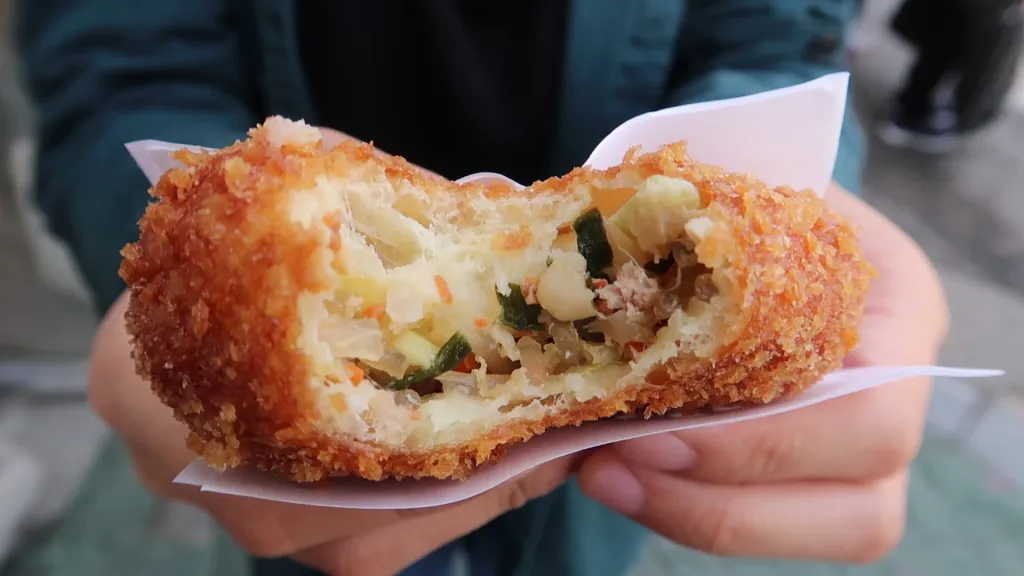
Next I would spend just ₩1,500 on one croquette. Current listings for a Mangwon Market handmade croquette shop show options in roughly the ₩1,000 to ₩1,500 range depending on the filling. That is almost absurdly convenient for a budget crawl because it lets you add another completely different food without sacrificing much money.
I would choose a savory filling rather than a sweet doughnut here, probably vegetable, kimchi, curry, or something with japchae if available. The point is not that a croquette is the rarest Korean food in Seoul. It is that Mangwon makes it easy to add one hot, crunchy, filled snack between larger stops for less than the price of a convenience-store drink in some neighborhoods.
This is another food where more is not necessarily better. Croquettes are deceptively heavy because you have bread, filling, and a fried exterior in one package. Buying four because they look cheap is exactly how a ₩20,000 food crawl turns into a ₩6,000 bread lunch followed by carrying everything else home.
I would eat this one immediately. A room-temperature croquette in a paper bag later at the river is fine, but it is nowhere near as good as the first few minutes after it comes out warm. Save portable foods for later and use the market itself for the foods whose texture actually depends on timing.
4. ₩4,000: Kalguksu Is Where I Would Spend My Meal Money
♡ Instead of blowing the budget on more fried snacks, I would use ₩4,000 for an actual bowl of noodles.
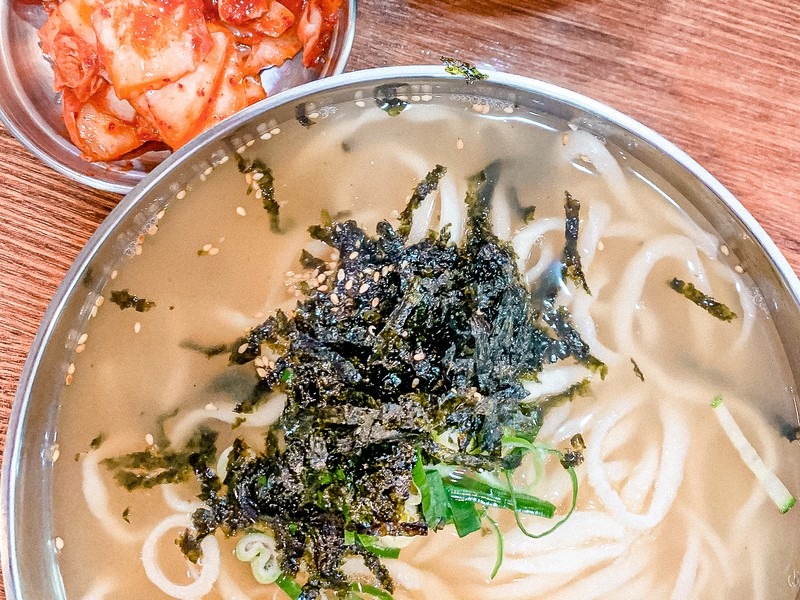
At some point, I want something that feels like food rather than an endless sequence of fried bites. That is where Gohyangjip's kalguksu comes in. Recent menu listings put a standard bowl of kalguksu at around ₩4,000, which is remarkably useful when your total budget is only ₩20,000.
Kalguksu is a Korean knife-cut noodle soup, and I especially like the idea of putting it in the middle of this crawl. The hot broth resets things after sweet dakgangjeong and a fried croquette, and it gives the whole outing an actual meal underneath the snacking. On a cold Seoul day, I might even make this the first stop and build the snacks around it.
There is a tradeoff. A full bowl of noodles is the most filling item in this entire plan. If you are alone and have a small appetite, this is the item most likely to make the remaining budget irrelevant because you simply will not want more food. In that situation, I would either skip the noodles or accept that several later items are coming home with me.
For two people, the calculation gets easier. One person can focus on the noodles while both people share the smaller snacks. I would not assume every restaurant wants two diners sharing one bowl during a busy period, though, so follow the shop's seating or ordering rules rather than treating a budget challenge as a reason to make things awkward for the owner.
5. ₩3,000: I Would Pick the Fried Pepper Over Another Chicken Snack
♡ A stuffed fried green pepper gives this crawl something that feels much more tied to Korean market food.
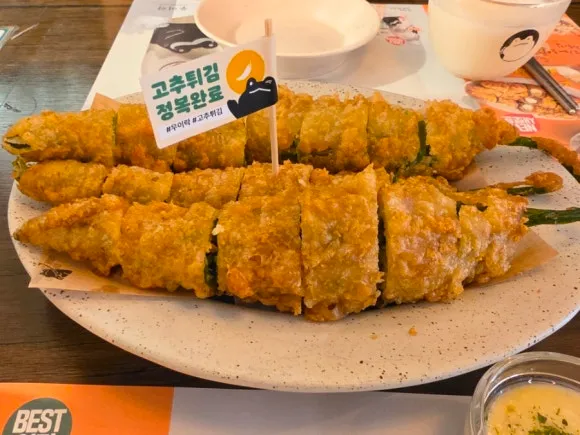
My next ₩3,000 would go toward a king fried green pepper. Current menu listings at Songine show one at around ₩3,000, and official Korea tourism material also singles out crispy fried green peppers as one of the foods associated with Mangwon Market.
This is one of the places where I would deliberately choose variety over fame. There are more heavily viral pepper options around Mangwon, but on a strict ₩20,000 crawl I do not need the most photographed possible version. I want the experience of biting through crisp batter into a pepper and savory filling while keeping enough money for the rest of the route.
I also think this is more interesting than adding another serving of fried chicken. Once I already have dakgangjeong in the plan, spending another chunk of the budget on a second chicken item gives me less contrast. A stuffed pepper introduces a different texture and a more recognizably Korean market-style fried snack.
If you are extremely sensitive to spice, ask before ordering rather than assuming a large Korean green pepper will be mild. Many are not aggressively hot, but peppers vary. The bigger practical concern for me is freshness. Like the croquette, I want this hot, not thirty minutes later after steam has softened the coating inside a takeaway bag.
6. ₩4,500: Gimbap Plus a ₩1,000 Tteok Skewer
♡ This is the practical part of the budget: one portable food for later and one nostalgic snack to eat while walking.
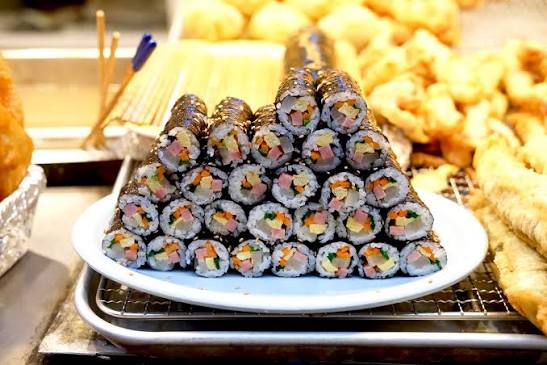
I would stay at the same general bunsik stop and use another ₩4,500: around ₩3,500 for a simple vegetable gimbap and ₩1,000 for a tteok skewer. That brings the running total to ₩18,000 and, more importantly, adds food that serves a different purpose from everything before it.
The gimbap is not here because I think basic vegetable gimbap is the most exciting thing in Mangwon Market. It is here because it is useful. It travels well, it is easy to split, and it gives you rice, vegetables, and a more neutral flavor after several fried or sauced foods. If I start getting full, this is what I would wrap up and take with me.
The ₩1,000 tteok skewer is the opposite. It is the cheap, slightly nostalgic impulse buy that makes a market crawl fun. For very little money, you get chewy rice cake on a stick with sauce and another distinctly Korean snack without committing to an entire ₩5,000 serving of tteokbokki.
That is actually why I would choose the skewer rather than a full plate of tteokbokki for this challenge. I like tteokbokki, but current menu listings around Mangwon commonly put a serving around ₩5,000. I already have noodles and gimbap in this plan. Spending another quarter of the entire budget on a bowl of rice cakes would make the crawl heavier while reducing the number of different things I can try.
7. Final ₩2,000: Finish With Hotteok
♡ The last ₩2,000 goes to dessert, and this is one food I would not save for later.
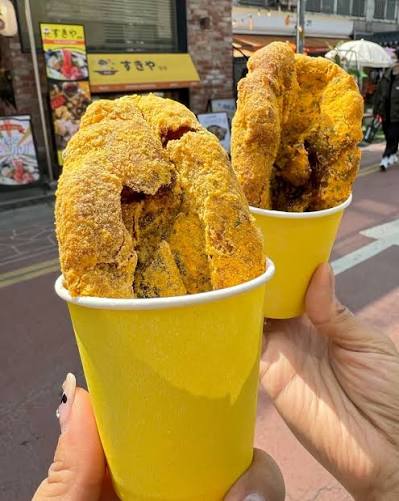
I have exactly ₩2,000 left, which is almost too convenient because recent Hoon-Hoon Hotteok menu information lists several flavored versions around that price. Depending on what is available, I would go for something like seed, injeolmi, or another simple flavor rather than trying to turn dessert into a giant overloaded creation.
Hotteok makes sense as the finish because it changes the rhythm of the crawl. After chicken, noodles, rice, and fried savory food, you get chewy fried dough and a sweet filling. More importantly, it gives the ₩20,000 limit a natural ending. There is no "maybe one more thing" because the wallet is now at zero.
I would wait until I am actually ready to eat it before ordering. Hotteok is one of those foods where temperature is part of the point. Fresh from the griddle, the outside is chewy and lightly crisp while the filling is almost dangerously hot. Twenty minutes later in a paper sleeve, it is simply not the same experience.
This is especially good in cooler weather. In the middle of Seoul summer, when Mangwon's covered market already feels warm and I am carrying several other foods, hotteok is less emotionally convincing. I would still eat it for the challenge, but in winter it is one of the parts I would genuinely look forward to most.
8. What I Would Skip on a ₩20,000 Budget
♡ Good food can still be the wrong choice when every extra ₩5,000 eliminates another stop.
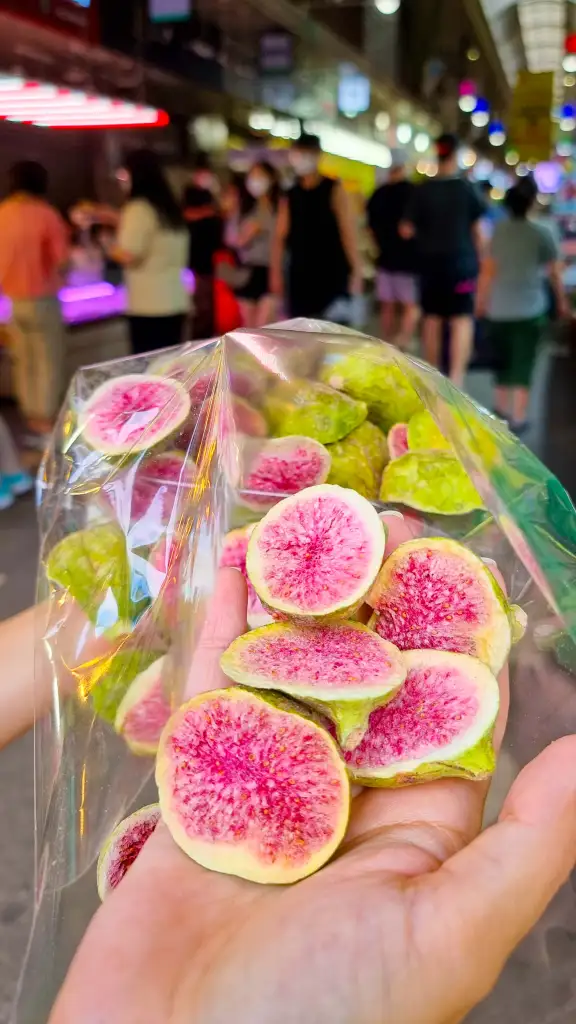
A useful budget guide should tell you what not to buy too. The first thing I would skip is a large dakgangjeong box. It can absolutely be better value per piece, but a market crawl is not supposed to optimize chicken volume. The ₩5,000 cup lets me taste it and move on.
I would also skip a full tteokbokki order in this particular plan. That is not because Mangwon tteokbokki is bad. It is because I already have a full bowl of kalguksu, gimbap, and a tteok skewer. Something has to lose when the budget is fixed, and I would rather keep the noodle soup plus several smaller snacks than add another large carbohydrate-heavy dish.
Drinks are another easy cut. Mangwon-dong has enough cafés that I would rather finish the market first and buy coffee separately if my real day budget allows it. Spending ₩4,000 to ₩6,000 of the challenge money on a drink would wipe out two or three of the inexpensive market foods that make this experiment interesting.
I would not chase every viral stall either. Mangwon is popular enough now that some people arrive with a saved list and treat every queue as proof that the food must be essential. I do not think that is the best way to use the market. If one line is enormous and an appealing stall next door is actively cooking something fresh, I am comfortable changing the plan.
Finally, I would skip buying souvenirs until the challenge itself is finished. Traditional sweets, rice cakes, nurungji, fruit, and other market products are worth browsing, but they belong in a separate shopping budget. Otherwise the supposedly ₩20,000 food crawl becomes a ₩35,000 market visit with creative accounting.
9. How I Would Actually Do the Crawl
♡ The order matters less than avoiding the worst crowds, eating fried food while it is hot, and not carrying everything from the first five minutes.
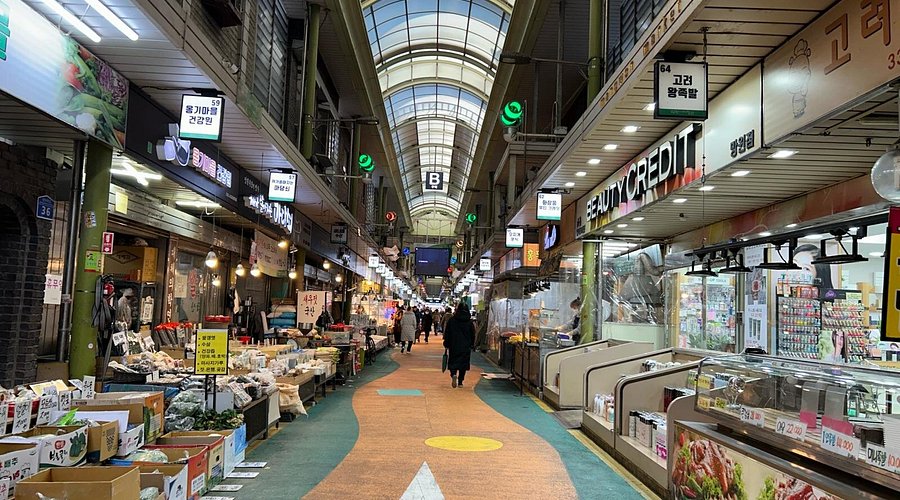
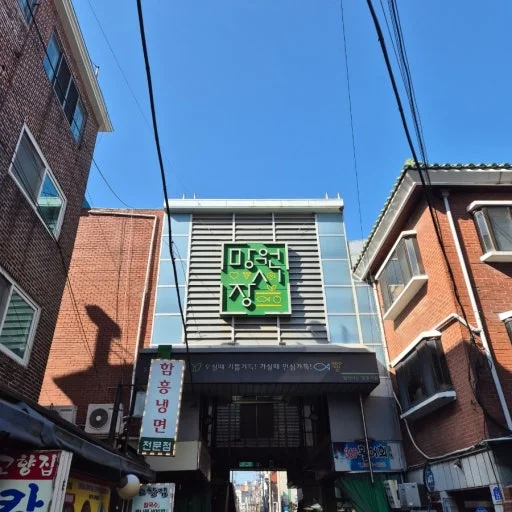
Mangwon Market is reached from Mangwon Station on Seoul Subway Line 6. Visit Seoul currently places it about 351 meters from Exit 2 and lists general market operating hours of 10:00 to 21:00, with individual shop hours varying. I would personally aim for late morning or early afternoon rather than showing up exactly when the market opens or arriving near closing and expecting every specific food stall to still be running.
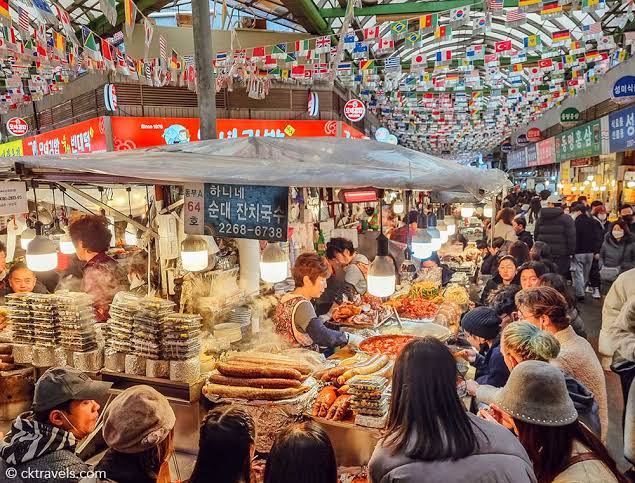
A weekday is my preference if you have control over the itinerary. Mangwon is compact, which is part of its charm, but that also means a relatively small number of people stopping in the same aisle can make the market feel much busier. Weekends are still fun, especially if you like energy, but queues and people standing around with food can slow the crawl considerably.
I would allow around 90 minutes to two hours for this version. You can walk through Mangwon Market much faster than that. The time is for ordering, eating, waiting for freshly cooked food, sitting down for noodles, and giving yourself enough space between stops that the whole exercise does not become an eating contest.
I would start with the foods that are easy to buy in small portions, take the noodle break somewhere around the middle, eat the fried pepper while it is still hot, and leave hotteok until the very end. Gimbap and leftover dakgangjeong are the two items I am most willing to carry out of the market.
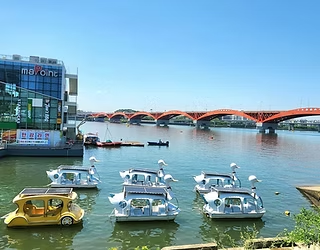
Then I would continue through Mangwon-dong rather than immediately returning to the subway. The streets around the market have cafés, small shops, and a completely different pace from the more heavily commercial parts of Hongdae. Official tourism guidance also recommends taking Mangwon Market food toward Mangwon Hangang Park, which is exactly what I would do if the weather is good.
This last part is important because I do not think Mangwon Market needs an entire day by itself. The better itinerary is market plus neighborhood plus river. You get the traditional market, contemporary Mangwon-dong, and the Han River in one area without spending half the day transferring between subway lines.
10. FAQ: Eating at Mangwon Market on a Budget
Can you really eat at Mangwon Market for ₩20,000?
Yes. Based on menu prices checked in September 2026, my sample basket totals exactly ₩20,000: a ₩5,000 dakgangjeong cup, ₩1,500 croquette, ₩4,000 kalguksu, ₩3,000 fried pepper, ₩1,000 tteok skewer, ₩3,500 vegetable gimbap, and ₩2,000 hotteok. Prices can change, so check current menu boards before ordering.
Is ₩20,000 enough for one person at Mangwon Market?
It is more than enough for a substantial food crawl if you choose inexpensive market foods. My exact ₩20,000 basket is actually a lot for one person to finish in one sitting because it includes noodles, chicken, gimbap, fried snacks, and dessert. Solo travelers may want to buy fewer items or take some food away.
Is this ₩20,000 crawl better for two people?
I think so. Two people can split the chicken, croquette, fried pepper, gimbap, tteok skewer, and hotteok while using the kalguksu as the more substantial meal component. Keep in mind that sit-down restaurants can have their own minimum-order rules, particularly when busy.
What is the cheapest food at Mangwon Market?
Prices vary by stall, but inexpensive bakery and bunsik snacks are still available. Current listings include some croquettes and doughnuts around ₩1,000 to ₩1,500 and simple tteok skewers around ₩1,000. These smaller items are useful if your goal is to taste several foods on one budget.
What would you prioritize if you only had ₩10,000?
I would choose either the ₩4,000 kalguksu or the ₩5,000 dakgangjeong cup as the main item, then use the remaining money for one or two smaller foods such as a croquette, fried pepper, tteok skewer, or hotteok. I would not try to reproduce half of the ₩20,000 list exactly because the best choices depend on whether you want a meal or snacks.
What would you skip at Mangwon Market on a budget?
For this particular challenge, I would skip large dakgangjeong portions, a full tteokbokki order, and drinks inside the ₩20,000 budget. None of those are bad choices, but they consume too much of a limited budget relative to the variety you can get from smaller foods.
How do I get to Mangwon Market?
Take Seoul Subway Line 6 to Mangwon Station and use Exit 2. Visit Seoul currently lists the market approximately 351 meters from the station exit.
What are Mangwon Market's opening hours?
Visit Seoul currently lists general market hours as 10:00 to 21:00 daily, while noting that hours vary by store. Individual food stalls can have separate closing days, opening times, or early sellouts, so check a specific shop if it is essential to your visit.
Should I bring cash to Mangwon Market?
Official Korea tourism guidance says most shops accept cards, but carrying some cash is still recommended because acceptance can vary. People living in Korea may also find bank transfer available at many market shops.
How long should a Mangwon Market food crawl take?
I would plan about 90 minutes to two hours if you want to eat several foods without rushing. Add more time if you are continuing through Mangwon-dong or walking toward Mangwon Hangang Park afterward.
Can I take Mangwon Market food to the Han River?
Yes. Official tourism material specifically recommends combining Mangwon Market with nearby Mangwon Hangang Park. Foods such as gimbap and dakgangjeong travel better than hotteok or freshly fried items, which I would eat at the market.
11. Sources and Planning Notes
This article mixes verified practical information with my own suggested food-crawl strategy. Mangwon Market operating information, transportation, commonly recommended foods, and the suggestion to combine the market with Mangwon Hangang Park were checked against official Seoul and Korea tourism resources.
VISITKOREA: Mangwon-dong and Mangwon Market
At the time this article was prepared, Visit Seoul listed Mangwon Market at 27 Poeun-ro 6-gil, Mapo-gu, approximately 351 meters from Mangwon Station Exit 2. General market hours were listed as 10:00 to 21:00, with individual store hours varying.
The ₩20,000 calculation uses menu prices publicly listed when checked in September 2026. Those included approximately ₩5,000 for a Q's dakgangjeong cup, ₩1,000 to ₩1,500 for selected croquettes, ₩4,000 for standard kalguksu at Gohyangjip, ₩3,000 for a king fried pepper, ₩1,000 for a tteok skewer, ₩3,500 for vegetable gimbap, and around ₩2,000 for selected Hoon-Hoon hotteok flavors.
Prices, flavors, serving sizes, store hours, holidays, and menu availability can change. If reproducing this exact challenge is important to you, check the current menu board before buying the first item and adjust the later stops if a price has changed.
The choice to skip full-size tteokbokki, large chicken portions, drinks, and certain more expensive viral options is my personal recommendation for maximizing variety within ₩20,000. It is not an official ranking of which Mangwon foods are best.
Want More Seoul Food and Neighborhood Guides?
Join the list for Seoul food finds, Korean culture, cafés, neighborhoods, K-beauty, shopping, and practical local guides that help you decide what is actually worth fitting into your Seoul itinerary.
Planning a trip to Seoul?
12. Final Thoughts
What surprised me most while building this budget was not that ₩20,000 can buy a lot of food at Mangwon. It is that the cheap items are what make the crawl interesting.
The ₩1,500 croquette and ₩1,000 tteok skewer give me more variety than upgrading a chicken box. The ₩4,000 kalguksu gives the day a proper meal without taking over the budget. The ₩3,500 gimbap is not the flashiest purchase, but it is the thing I can actually carry to the river when I inevitably realize I ordered too much.
And that is how I would approach Mangwon generally. I would not come here trying to prove I ate every food that went viral. I would choose a few things that are genuinely better fresh, use the cheap snacks to create variety, and stay flexible enough to change the plan when something looks better in person.
If two people handed me ₩20,000 and asked me to plan their first Mangwon Market crawl, I would be perfectly happy with this list. If I were alone, I would probably eat the chicken, croquette, pepper, noodles, and hotteok first, pack the gimbap, and take the long way toward Mangwon Hangang Park.
That last part matters more to me than squeezing an eighth snack into the budget. Mangwon is better when the market is the start of the afternoon, not the entire objective.